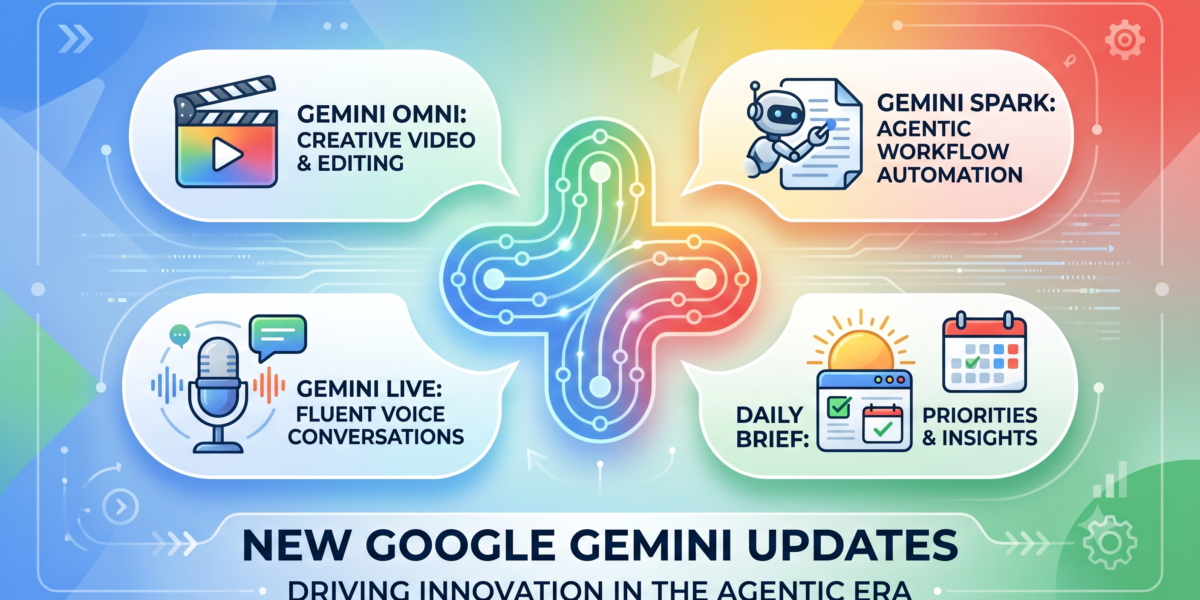
- Google launched Gemini Omni — a multimodal model that creates and edits video from any input including text, images, and audio — available today for paid subscribers
- Gemini Spark is a 24/7 AI agent that runs in the cloud and autonomously takes actions in Gmail, Docs, and third-party apps on your behalf — without you keeping your device open
- Google AI Studio now supports Android vibe coding — anyone can build a working Android app from a plain English prompt, no programming knowledge required
- Samsung’s Android XR smart glasses with Gemini integration were officially unveiled — the first real-world AI glasses with Google intelligence built in
- Google Antigravity 2.0 — the agent-first developer platform — is now globally available, with MCP support for third-party tool integration
Google held its annual developer conference I/O 2026 on May 19-20 at Mountain View, California — and it was the most AI-dense keynote the company has ever delivered. New models, new agents, vibe coding for Android, AI-powered smart glasses, and a complete redesign of the Gemini app. This is a complete breakdown of every major announcement and its practical implications for professionals.
Google I/O used to be about Android version numbers and new Pixel hardware. Today it is about something much larger: the systematic replacement of passive AI tools with autonomous agents that act, build, and decide on your behalf. At I/O 2026, Google did not just announce features — it announced a philosophical shift. The company is moving from AI that answers questions to AI that takes actions. Every major announcement today reflects that shift.
Gemini Omni: The Model That Creates Anything From Anything
The headline model announcement is Gemini Omni — Google’s most capable multimodal model to date. Gemini Omni Flash accepts image, audio, video, and text input and outputs video grounded in real-world knowledge that can be easily edited. This is not incremental. Previous AI models either generated images or generated text. Gemini Omni generates, edits, and transforms video — taking a clip you upload and reshaping it through natural language prompts.
The demonstration at I/O showed a user uploading an existing video and using plain text prompts to rotate the framing, add elements, and change the visual style — all without touching video editing software. Gemini Omni got demoed at I/O, showing how you can create a video you’ve uploaded with additional prompts to transform it to something else, like being able to rotate the framing and adding other elements.
For Indian content creators, marketing professionals, and entrepreneurs currently paying for video editing tools and freelancers, Gemini Omni represents a significant shift in what one person can produce alone. Gemini Omni is available for paid Plus, Pro, and Ultra subscribers in the Gemini app today, and rolling out to Google Flow and YouTube Shorts.
Gemini Spark: Your First AI Agent That Works While You Sleep
If Gemini Omni is about creation, Gemini Spark is about action. Gemini Spark is “your personal agent” that takes actions on your behalf to help “navigate your digital life.” It integrates with Gmail, Docs, and other Google Workspace apps before expanding to other third-party tools via MCP over the summer.
The critical technical detail that separates Spark from every previous AI assistant: it runs 24/7 in dedicated virtual machines — so you won’t need to keep your laptop or phone open for it to work. This is a genuine architectural leap. Every AI assistant before Spark — including ChatGPT, Claude, and previous Gemini versions — required you to be in an active session. Spark runs continuously in the cloud, monitoring your email, calendar, and tasks, and taking action without you initiating a conversation.
The practical implications are significant. Spark can draft and send responses in Gmail, update documents, reorganise your calendar, and complete delegated tasks autonomously — not just suggest what you might want to do. Gemini Spark will be available next week to Google AI Ultra subscribers in the US, with broader rollout following.
Daily Brief: The Morning Digest Agent
Daily Brief is a personalized digest of the day ahead. Sifting through your Gmail, Calendar, and Tasks, it prioritizes and organizes what you need to do, while suggesting next steps. It is rolling out today for paid subscribers.
For professionals who start their mornings managing inbox overload, Daily Brief is a practical productivity tool. Rather than opening Gmail, Calendar, and Tasks separately and constructing your own priorities, Spark’s Daily Brief does this automatically and presents a structured, prioritised view of what matters. It is worth noting the direct parallel to what TheTrendingOne’s own Morning Brief does for news — Google has essentially built the same concept for personal productivity.
Google AI Studio: Vibe Coding Is Now For Android
This is the announcement most relevant to the image you shared — and it is genuinely significant. Google AI Studio now supports native Android vibe coding — introducing native Android vibe coding support, Google Workspace integrations, an AI Studio mobile app and more.
Vibe coding is the practice of building software through natural language prompts rather than writing code. Until now, vibe coding tools primarily produced web apps and browser-based experiences. Google has extended this to native Android app development — meaning anyone with a smartphone and an idea can generate a working Android application from a plain English description, without writing a single line of code.
The image you generated in Gemini illustrates this perfectly — Gemini Spark handling agentic workflow automation is exactly the kind of experience that AI Studio now lets non-developers build into their own custom apps. The barrier to building software on Android has effectively fallen to zero for anyone willing to invest time describing what they want.
Google Antigravity 2.0: The Agent-First Developer Platform
Google Antigravity 2.0 is agent-first and globally available today. Google is focusing on improving Gemini on Agentic Coding, Long-Horizon Tasks, and Real-World Workflows. Antigravity is Google’s framework for developers building applications on top of Gemini agents — the infrastructure layer that powers both Spark and the new AI Studio capabilities.
The MCP (Model Context Protocol) support is particularly important for developers. Gemini Spark integrates with Google Workspace apps and will expand to third-party tools via MCP over the summer. MCP is the same protocol that Anthropic developed and which has been adopted across the AI industry — its inclusion in Google’s platform signals a meaningful step toward interoperability between AI systems.
Samsung Android XR Glasses: The Hardware Play
Google’s opening keynote featured Samsung’s long-awaited Android XR smart glasses — the first Android XR audio glasses, coming this fall with iPhone support. The glasses run Android XR, Google’s augmented reality operating system, with Gemini integration for real-time AI assistance delivered through audio rather than a screen.
The practical use case for Indian professionals travelling or commuting is genuine: Gemini in your ear, answering questions, taking notes, and surfacing relevant information without requiring you to look at a screen. The iPhone support is a notable and commercially savvy choice — it dramatically expands the potential market beyond the Android faithful.
Everything Else: The Full Announcement List
| Announcement | What It Does | Availability |
|---|---|---|
| Gemini 3.5 Flash | New model combining frontier intelligence with real-world action | Rolling out now |
| Neural Expressive Design | Complete Gemini app redesign — fluid animations, haptic feedback, vibrant UI | Android, iOS, Web today |
| Gemini Live | Free-flowing voice conversations — talk without being cut off mid-thought | Available now |
| Universal Cart | AI shopping agent that tracks prices, history, and proactively finds deals across the web | Rolling out US first |
| Google Flow Mobile | AI video and music creation app — Flow on Android beta, Flow Music on iOS now | Available today |
| Google Pics | New AI-powered design tool announced for visual creation | Coming soon |
| SynthID Expansion | AI watermarking now detects AI-generated images in Search and Chrome (right-click) | Rolling out |
| Docs Live + Gmail Live | Voice-to-document creation in Docs; AI-powered email search in Gmail | Rolling out |
| Gemini for Science | New collection of science tools expanding the scale of scientific exploration | Available |
Google vs Anthropic vs OpenAI: Who Wins After I/O 2026?
The honest answer to “which AI should I choose” changed meaningfully today. Here is where each company stands after Google’s announcements.
Google’s structural advantage is integration. Gemini Spark integrates with Gmail, Docs, and other Google Workspace apps and runs 24/7 in dedicated virtual machines. If your professional life runs on Google Workspace — which describes the majority of Indian startups, agencies, and professionals — Google’s integrated ecosystem now offers something Anthropic and OpenAI cannot: agents that are already inside the tools you use, without any configuration. You do not set up a connection between Gemini and Gmail. It is already there.
Anthropic’s Claude maintains its lead in one critical dimension: the quality of analytical reasoning and long-form writing. Claude’s outputs on complex analytical tasks — strategy documents, research synthesis, nuanced editorial work — remain superior to Gemini equivalents in head-to-head testing by most practitioners. Claude Code, Anthropic’s coding tool for developers, competes directly with Google’s vibe coding but targets professional developers rather than non-coders.
OpenAI’s ChatGPT retains the broadest versatility and the most established web search integration. GPT-5’s real-time web access and the breadth of third-party integrations remain competitive advantages, particularly for research-heavy workflows.
The practical framework: after I/O 2026, Google has the strongest case for professionals who live in Google Workspace and want autonomous agents that act without prompting. Anthropic has the strongest case for professionals who prioritise writing and analytical quality over automation. OpenAI has the strongest case for professionals who need maximum versatility and real-time information access.
The emerging reality is that the “which AI is best” question is increasingly the wrong question. The companies are differentiating on architecture — Google on integration and agentic action, Anthropic on reasoning quality and safety, OpenAI on breadth and accessibility — rather than on raw capability. Most power users will run two or three tools simultaneously rather than committing to one.
3 Frequently Asked Questions
Q: Are today’s Google I/O 2026 announcements available in India?
Most features are rolling out globally but with a US-first priority. Gemini Omni in the Gemini app, Neural Expressive redesign, Gemini Live, and Daily Brief are available to Indian paid subscribers today or within days. Gemini Spark — the autonomous 24/7 agent — launches next week for Google AI Ultra subscribers in the US, with international availability expected over the summer. Google AI Studio’s vibe coding for Android is globally available today.
Q: How much does Google AI Ultra cost and is it worth it?
Google AI Ultra — which gives access to Gemini Spark, Gemini Omni, and all premium features — starts at $100 per month in the US. For Indian users accessing through Google One, pricing has historically been lower. Whether it is worth it depends entirely on your Workspace usage: for professionals who spend 4+ hours daily in Gmail and Docs, the autonomous agent capabilities could save enough time to justify the cost easily. For light users, the lower-tier Plus plan at $20 covers most non-agent features.
Q: What is “vibe coding” and how do I try it in Google AI Studio?
Vibe coding is building software by describing what you want in plain language instead of writing code. In Google AI Studio, go to ai.google.dev — the platform is free to access. Select the Android app option, describe your app idea in plain English (“a daily habit tracker with a home screen widget and daily reminders”), and the system generates a working Android project. You can download and run it directly on an Android device or emulator. No programming background required for basic apps, though technical knowledge helps for customisation.
The story from Google I/O 2026 is not about any individual feature. It is about a strategic repositioning that has been building for 18 months: Google moving from a company that provides AI tools to a company that provides AI infrastructure embedded in every product it already owns. Gemini Spark running 24/7 in virtual machines inside Gmail is not a feature. It is Google saying — we are not competing for your attention session by session. We live in your workflow now.
The vibe coding announcement deserves more attention than it is getting. When anyone can describe an Android app in plain English and have it generated in minutes — without a developer, without a budget, without technical knowledge — the barrier to building software falls to near zero. This is not a productivity improvement. It is a structural change in who can build products. A 22-year-old in Patna with a phone and a good idea can now build and ship an Android app in an afternoon. That is new.
For Indian professionals choosing between AI tools: Google wins on integration if you live in Workspace. Claude wins on reasoning quality if you write and analyse for a living. OpenAI wins on versatility if you do a lot of different things. The honest answer after today is that the gap between these platforms on raw capability has narrowed significantly — but the gap on ecosystem integration has widened in Google’s favour. Choose based on where your work actually happens, not based on which benchmark headline you last read.

[…] of imported systems, Kavach has been deployed across approximately 5,000 route kilometres as of May 2026. The Railway Board has mandated full network coverage of priority routes by December 2027, with the […]
[…] globally, reported revenue from operations of ₹32,356 crore for the quarter ended March 2026, marking an 8 per cent increase from the corresponding period last […]
[…] to functional implementation, suggesting that concrete compliance changes will materialize in late 2026 or early […]
[…] clarified that Aadhaar Card will not be mandatory for candidates registering for the UGC NET June 2026 examination. The announcement comes as a relief for thousands of prospective applicants, […]