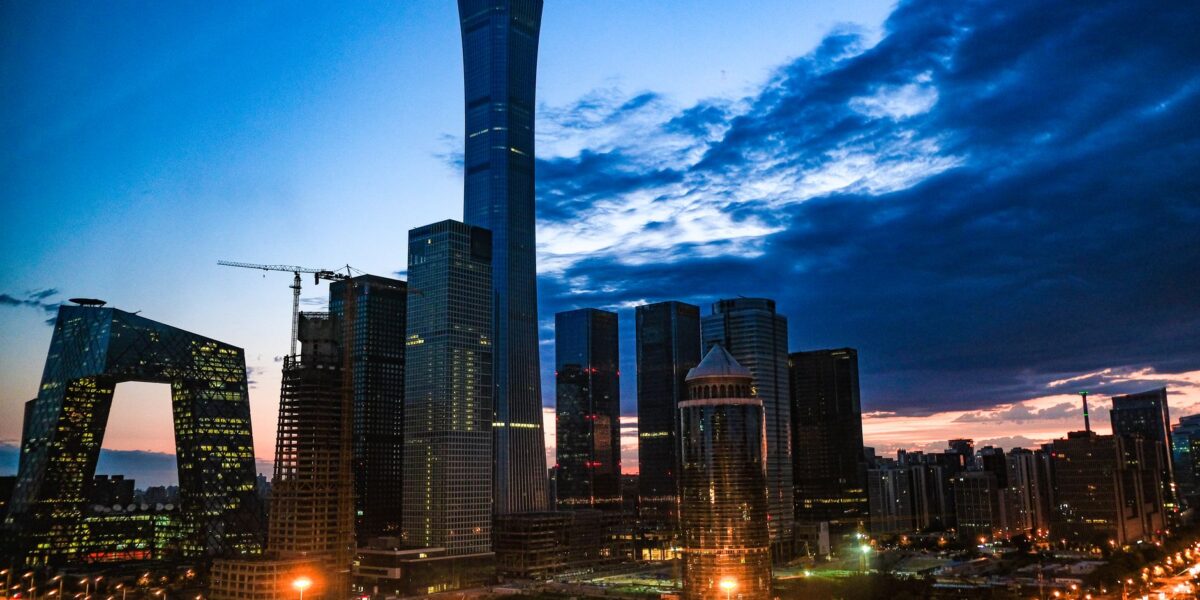
Typhoon Noul made landfall in southern China on Saturday as the year's most powerful storm to hit the mainland, with video footage capturing construction scaffolding being violently ripped from a Hong Kong building as the system intensified. The category-equivalent storm marks a critical stress test for supply chain resilience in one of the world's most densely industrialized regions, with immediate implications for manufacturing, logistics, and consumer goods exports flowing into global markets.
The typhoon struck coastal Guangdong province with maximum sustained winds exceeding 150 kilometers per hour, according to Chinese state media reports. Hong Kong, just across the border, experienced severe weather conditions that disrupted port operations, transportation networks, and forced the closure of non-essential businesses. The scale of the system—the strongest to make landfall in mainland China this year—underscores the intensifying climate volatility affecting Asia's economic epicenter.
The storm arrives at a delicate moment for global supply chains already strained by geopolitical tensions and shifting trade patterns. For Indian importers and manufacturers dependent on Chinese components, semiconductors, and chemicals, any prolonged disruption compounds existing cost pressures and delivery timelines.
What Happened
Typhoon Noul developed in the Western Pacific and tracked westward toward the Chinese coast over several days, with meteorological agencies issuing escalating warnings as the system intensified. When it made landfall near Zhanjiang in Guangdong province on Saturday, it brought destructive winds, heavy rainfall, and storm surge conditions that affected millions of people across the region. The dramatic footage of scaffolding being torn from a Hong Kong building exemplifies the physical force unleashed—a visible reminder of the typhoon's raw destructive capacity in an urban setting.
Guangdong province is home to some of the world's most critical manufacturing and export hubs. Cities like Shenzhen, Dongguan, and Foshan drive production of electronics, textiles, chemicals, and petrochemicals. The province's ports, particularly Shenzhen and Guangzhou, rank among the busiest globally. The timing of a Category 4-equivalent typhoon striking this region creates immediate operational disruption and extends risks into supply chain recovery timelines.
State media confirmed this was the strongest typhoon to make landfall in mainland China during 2026, marking it as a significant weather event in a year already experiencing multiple tropical cyclones. The classification carries weight—it signals the magnitude of potential damage, the scale of response required, and the duration of recovery operations needed to restore normal economic activity.
Why It Matters For Professionals
The immediate economic impact radiates outward from Guangdong through global supply networks. Manufacturing facilities face forced shutdowns as workers shelter, utilities are disrupted, and transport links become impassable. For companies importing finished goods or components from this region, delivery delays accumulate within 48 to 72 hours, creating cascading effects through inventory management systems and production schedules worldwide.
For professionals in procurement, supply chain management, and logistics, this event serves as a live case study in systemic risk. Manufacturers who built redundancy into their sourcing strategies—holding multiple suppliers across different geographic regions—will experience minimal disruption. Those concentrated in Guangdong face acute pressure. The cost differential between resilient and brittle supply chains becomes measurable in real time. Companies that had over-indexed on "just-in-time" manufacturing are absorbing material costs as they scramble to secure alternative suppliers or expedite shipments from other regions at premium rates.
For equity investors, the event creates a temporary repricing opportunity. Manufacturing stocks tied to export volumes from southern China may face downward pressure as forward guidance becomes uncertain. Conversely, logistics companies providing rerouting services, alternative suppliers in Vietnam or Thailand, and those positioned to fill supply gaps may see margin expansion. The professionals who act decisively within 48 hours—repositioning capital toward winners and away from forced sellers—capture asymmetric returns.
For importers in India, the immediate question is lead time. A one-week port closure transforms into a three-week manufacturing delay once components reach Indian facilities. Chemical importers, electronics assemblers, and textile manufacturers dependent on Guangdong-origin inputs face cost inflation if they need to source alternatives at spot prices. However, longer-term professionals recognize this as temporary. Markets adjust. Alternate suppliers activate. Prices normalize within 30 to 45 days for most commodity-like inputs.
What This Means For You
If you manage procurement for an Indian manufacturer, your immediate action is auditing your supplier concentration in Guangdong. Pull your sourcing data for the past 12 months and identify which suppliers are actually in the typhoon zone. This takes two hours. Once identified, contact alternatives now—not when your primary supplier goes offline. Spot price differentials today are recoverable if you act before bottlenecks form.
If you have equity exposure to Chinese manufacturers or logistics companies with heavy Guangdong operations, the next 48 hours of damage reports matter. The stock market will overshoot—selling indiscriminately on headline risk. By day five or six, when damage becomes quantifiable and recovery timelines crystallize, the repricing will be more rational. Position accordingly based on your time horizon. If you trade on three-to-six-month views, waiting for clarity before adding positions is defensible. If you invest on five-year horizons, indiscriminate selling by panicked traders creates entry points.
What Happens Next
The immediate priority for Chinese authorities is search and rescue, damage assessment, and restoration of critical infrastructure. Port operations in Guangzhou and Shenzhen will likely resume partial operations within 48 to 72 hours, with full capacity returning over 7 to 10 days. Manufacturing facilities will conduct damage inspections and ramp production gradually as supply chains stabilize. Government stimulus measures—expedited insurance payouts, temporary tax relief, and infrastructure prioritization—typically follow major typhoons, providing economic support within 10 to 15 days.
For global markets, the event becomes fully priced within two weeks. Companies update guidance, logistics networks optimize rerouting, and alternate suppliers activate. By early August, market focus will shift back to macro drivers—interest rates, growth indicators, geopolitical tensions—rather than weather disruption. However, for Indian companies with concentrated sourcing exposure to this region, the recovery trajectory extends further. Expect import-cost inflation through mid-August and gradually normalizing conditions by September.
3 Frequently Asked Questions
Will Typhoon Noul create sustained inflation in imported goods for Indian companies?
A: Temporary, not sustained. Port and manufacturing operations resume within 7 to 10 days. Supply chains adjust within 30 to 45 days. Spot price premiums paid by importers caught unprepared will be reabsorbed as normal supply resumes. Companies should absorb spot costs as one-time events rather than planning for structural inflation. However, if this is the third or fourth supply disruption in 18 months—from geopolitical tensions, pandemic-related logistics chaos, or other typhoons—then structural redundancy becomes economically justified.
Should I move my manufacturing sourcing away from Guangdong permanently?
A: No. Guangdong is the center of gravity for manufacturing efficiency, cost, and scale. A single typhoon—even a severe one—does not justify reshoring or wholesale diversification. However, strategic redundancy does justify business. Identify your 15 to 20 percent of highest-value inputs and dual-source them across Guangdong and alternative regions. The cost premium for dual-sourcing is insurance against systemic risk. The math works if you avoid even one major disruption in five years.
How will this affect Indian stock markets?
A: Indirectly. Indian exporters dependent on Chinese components may see margin pressure near-term. Import-substitution and domestic manufacturing plays may see temporary investor optimism. However, the broader market impact is limited unless this disruption reveals deeper structural fragility in Chinese supply chains—which it does not. One typhoon is an act of nature. Repeated disruptions would signal structural problems. Expect a one-to-two percent market wobble if sentiment weakens, followed by stabilization as damage assessments become clear.
This is not a weather story. This is a supply chain concentration story. Every large Indian importer just got a free lesson in what happens when you build your sourcing around a single geographic hub—and it will cost many of them money. The professionals who respond in the next 48 hours, who pull their supplier data and activate backup suppliers before scarcity pricing kicks in, will save tens of lakhs. The others will pay the penalty of indecision. Act now: audit your Guangdong exposure, contact your top three alternative suppliers, and lock in pricing before demand spikes. Second, if you trade in equity markets, watch the China exporters closely on Monday and Tuesday—the panic sell-off will be irrational. By Wednesday, when damage reports show recovery timelines in weeks, not months, the repricing will be mechanical and predictable. Position yourself ahead of that mechanical repricing. Third, if you invest with a multi-year horizon, ignore the noise entirely. Supply chains are resilient by design. One typhoon reshuffles timing but does not reshape the fundamentals of why China remains manufacturing central.
